
How Shawnee Works
From time to time, we’ll share more thorough explanations about what’s behind some of the City’s and the Council’s work. Our first topic is TIF districts, inspired by the proposal of the Midland TIF district. I couldn’t find an understandable explanation of TIF’s anywhere. So, I created my own. Please contact me if you still have questions.
All About TIF Districts
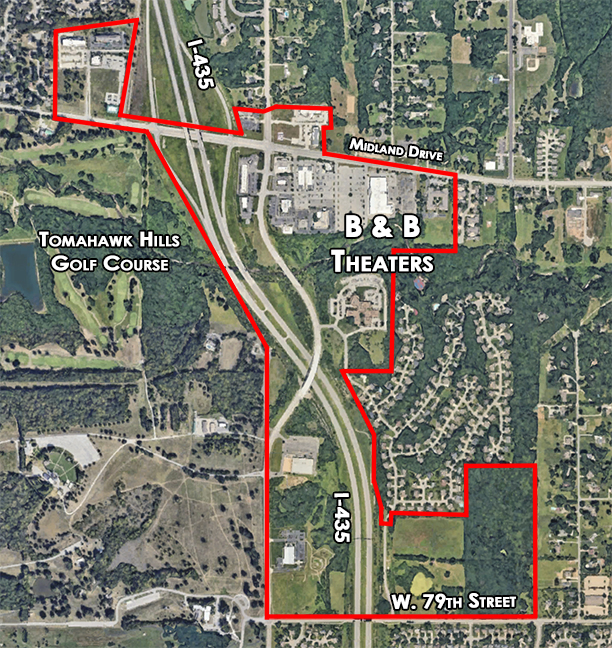
What's proposed for this area?
The proposed district includes the Midland Entertainment District and the B&B Theater complex. The owners have considered redevelopment concepts but need financial assistance to make them viable. A separate part of the district has challenging terrain that makes development unusually expensive. A developer has expressed interest in that land, but only if the City can help finance their preparation costs.
These are just two examples of value growth that wouldn’t happen without TIF benefits. In both cases, the TIF district offers the same practical answer: the City isn’t writing a check — it’s agreeing to direct future tax growth from the development itself back into the project until the costs are covered.
What is a TIF District?
TIF stands for Tax Increment Financing — a tool Kansas law provides to encourage redevelopment in areas where private investment hasn’t happened on its own. Before the City can create one, it must clear a specific legal hurdle:
- The area must qualify as “blighted” under Kansas law. This isn’t the City’s opinion. It’s a defined legal standard with specific checklists of conditions that meet the definition.
- The checklists all point to the same basic test. Does the area’s current condition hold back the city’s growth, slow down housing, or create economic, social, or safety problems for the public?
- City staff will present a study at the public hearing documenting which conditions exist in this area.
- The Council must formally confirm that finding before the district can be created.
How does the financing work?
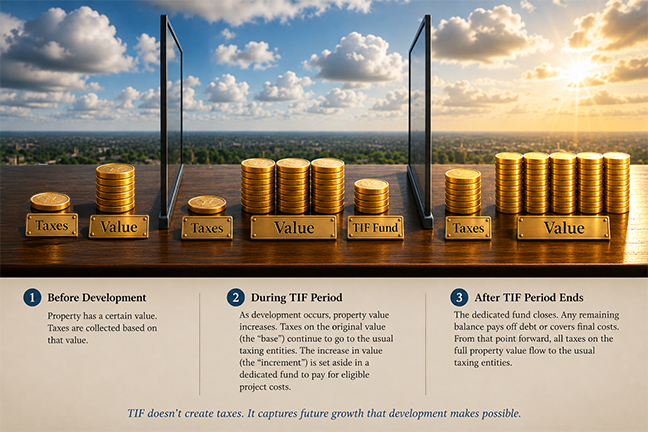
When the TIF district is created, the current property value becomes the “base.” Here’s what happens from that point forward:
- Existing tax revenue is protected. The city, county, and other taxing entities keep collecting exactly what they collected before — based on that base value.
- The school district is fully protected by state law. Shawnee Mission USD 512 continues to collect its full share throughout the TIF period, and state funding formulas are calculated as if the TIF doesn’t exist. The school district doesn’t lose a dollar.
- Development raises property values and tax bills on the property within the TIF. Property owners pay their full tax bill every year based on current values as development occurs.
- The additional tax revenue goes into a dedicated fund. The city and county still receive only what they collected before development. The increase – the “increment” – goes into a separate account instead.
- The fund has strict limits. The City Council must approve every expenditure, and the money can only be used for land acquisition, site preparation, and public infrastructure
Think of it this way: the taxing entities aren’t giving up money they already have. They’re agreeing to set aside future tax increases that the development itself created. Without the TIF, that growth might never have happened at all.
How does it end?
A TIF agreement typically runs 20 years. When it expires, the dedicated fund closes and any remaining balance retires outstanding debt or covers final project costs. From that point forward, the full property tax on the now-more-valuable property flows to everyone — and the City reaps the long-term reward of a healthier tax base.
Subscribe to Our Newsletter
This information first appeared in our Ward Two newsletter. Please use this form to subscribe so you can see the news first.
After every City Council meeting, I send an email recapping the topics and decisions. I share helpful background, street construction plans, and local updates. A few times a year, I also take a deeper look at important topics, like the city budget.
There’s no politics and no sales pitch — just honest information. Read for as long as you like, unsubscribe anytime. And yes, it’s free.